The opening. Once a rooster was offered on red silk over stones around the idol, standing for Kali’s fight with Darika. The first-cock right is associated with the Thacholi clan of Vadakara. Today the stones are covered with red silk. Flags of the Venad family are hoisted on a peepul in the north-east.
Utsavam
Festivals
Meenam · March–April
Kodungallur Bharani
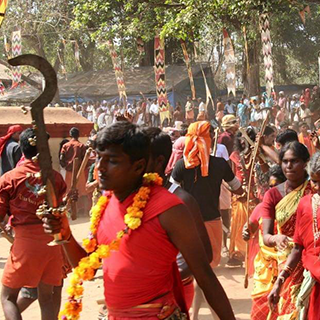
The temple’s great festival runs from the Bharani asterism in Kumbham to seven days after the Bharani of Meenam. Kerala Tourism describes it as one of the most intense celebrations in the state — a sea of red, and often called the largest gathering of oracles (velichappad) in the world.
It is not a polished pooram. It is old Shakta and folk devotion: oracles in red, bronze anklets, sickles, turmeric, and songs that address the mother without courtesy. Tradition says she accepts even harsh speech, because a mother hears every voice.
Live animal sacrifice is not part of the sanctioned modern festival. It has been banned since 1978. What remains of Kozhikkallu moodal is symbolic — red silk over the stones.
The heart of Bharani, often on Aswathy, the day before Bharani. The King of Kodungallur unfurls a red umbrella. Oracles run around the temple, strike the rafters, and throw turmeric, coconuts and offerings onto the inner quadrangle — ritually “polluting” the kavu. The temple then closes about a week for purification.
Raw ballads sung to the goddess. They can be abusive or erotic. This is not mockery from outside; it is a permitted form of address, kept by the festival itself. The most unrestrained song was traditionally given a prize by the king.
The lighting of the traditional lamp that marks the sacred time of the festival.
Also called Thrichandanacharthu. The image is smeared with sandalwood paste after the fury of Theendal has passed.
After Theendal the premises are swept and the wells purified. This is when Namboodiri priests enter to perform the cleansing, with pasu dhanam, the gift of cows. Prasadam taken home is sandal mixed with turmeric, and chantu — a black paste of burnt rice.
Sources: Wikipedia (Kodungallur Bharani festival); Kerala Tourism event page and 1000 Festivals PDF; Vanamali Ashram.
Makaram · January–February
Thalappoli
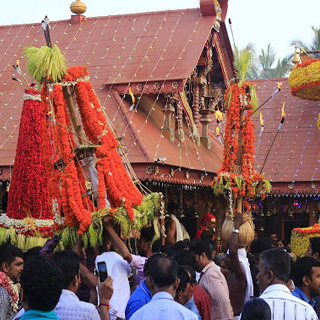
Four days from the evening of Makara Sankranti. This is the dignified festival of the year: elephants, kathina vedi (barrel crackers), and a procession of women in Kerala dress carrying a thalam — rice, a coconut-shell lamp, a lighted wick.
On the first day the Malayarayan community arrives with irumudi kettu, fasting, offering turmeric and pepper. The Kudumbi community comes with instruments and performs Savasini puja. On the third day the procession starts from Pathinettarayalam Kovilakam. The remaining days are organised by the Devaswom Board.
Sangam games are held at the temple during Thalappoli, in memory of the Sangam people associated with the Kannagi story.
The rest of the year
Navaratri and Chandattam
Navaratri
Through the nine nights the mother is worshipped in her gentler and royal forms — Maha Saraswati, Maha Lakshmi, and Durga who devotees also know as Kannagi. Tuesdays and Fridays already draw crowds; Navaratri fills the courtyard.
Chandattam
The wooden image is not stone. Each year she is given Chandattam — a bath of adhesive made of many ingredients — so the jackfruit timber holds. This is both conservation and worship.
Dates move
Festival days follow the Malayalam calendar and the temple’s own custom. Confirm the year’s dates with the Devaswom office before you travel. Approximate windows: Thalappoli in Makaram, Bharani in Meenam.